Gen Alpha Faith Trends: Helping today’s teens find identity, belonging, and purpose in a hybrid world
 David Martinez | May 5, 2026
We all know our teenage years are filled with figuring things out about ourselves, other people, and the world around us. Let’s not kid ourselves—adults can agree this exploration doesn’t end there. However, those earlier years are marked by heightened vulnerabilities and many influences. Today’s young people, in particular, may have an “
The teenage years are a formative time for meaning-making. In 3 Big Questions that Change Every Teenager, Kara Powell and Brad Griffin identified identity, belonging, and purpose as drivers for teenagers’ search for meaning. As a quick review: identity is our view of ourselves, belonging is our connection to others, and purpose is our contribution to the world.
Like most teenagers, I had my seasons of feeling lost in this world, asking different variations of these questions. I grew up in Alabama, raised by my parents, who had recently immigrated from Venezuela. There wasn’t a large immigrant community where I grew up, so I didn’t have anyone to share this experience with other than my siblings.
Naturally, people were always curious about my background and would ask, Where are you from? The thing is, I didn’t even know who I was. My mind was always filled with competing replies:
- I’m from here, but I don’t think that’s what they mean.
- Maybe they’re really asking where my parents are from.
- The question assumes I can’t be from here, yet I’m also not fully from somewhere else. What does this make my identity?
As a result, I wasn’t always sure where I fit in. While I had friends and a supportive community, there was often an unspoken part of myself that felt unresolved. Some of this may be unavoidable when navigating minority experiences. But more broadly, it reflects the deeper questions many adolescents face as they try to understand who they are and where they belong in the world.
As a Venezuelan-American, I have learned (and am still learning) how our intersecting identities play an important role in our way of being and how we interact with our world. I’ve realized that our identities can be layered and dynamic. Our layered identities shape how we experience God, others, and ourselves. I’ve found that I am met with love, curiosity, and safety in this complexity.
Generation Alpha is navigating identity, belonging, and purpose across physical and digital spaces, with faith and spirituality woven into that process for many. Notably, they are the most racially and ethnically diverse generation to date.[1] Meaning-making is still happening—but it is happening within greater complexity and nuance than ever before. If we’re paying attention, these realities invite youth leaders to rethink how we accompany young people in their search for meaning today.
How Gen Alpha finds meaning
Leaders like you have been asking us at FYI: What’s different about teenagers now—and how should we respond? Generation Alpha is coming into the picture, and the church is slowly gaining a better understanding of their experiences as they search for meaning. Thus, our team launched new research into how Gen Alpha (born 2010 and later) is exploring identity, belonging, purpose, faith, and spirituality.
One way this search for meaning shows up is in the questions teens ask when given space to reflect. At the end of a research interview I conducted with one teen, I asked him if he had any questions for me. He said, “Yeah… what do you think is our purpose?”
Even after an almost hour-long conversation, the participant was curious for more. This moment struck me as a reminder that teenagers are searching, and this search can be scary and isolating.
Gen Alpha is searching for meaning in and through relationships. Safe and consistent relationships act as an avenue for teenagers to figure out who they are and what their purpose is. Positive relationships have been shown to support adolescent development, including the growth of identity and purpose.[2]
Notably, our research found that family is a top influence when it comes to exploring identity, belonging, and purpose. While this is not the case for all teenagers, many express high levels of trust and safety here. Peers and friends follow closely as strong influencers for Gen Alpha. In fact, when asked questions about exploring identity and belonging, friends and family were practically tied in responses.
Gen Alpha under pressure
Humans naturally make meaning through the world we interact with. While not limited to Gen Alpha, accessibility to digital communities has offered new opportunities to learn and connect. However, unique to Gen Alpha is that they are the first generation to be fully immersed in a “hybrid” world. Social media is not limited to staying connected with friends or finding new pasta recipes. It’s also a space where we inevitably ask the three “big questions”: Who am I?, Where do I belong?, and What difference can I make?. This hybrid reality can quickly complicate today’s teens’ search for meaning.
Exposure to national and global information in the hands of any individual can be a heavy burden to carry. Today’s teenagers often feel pressure to stay informed and take action, yet when they are unsure how to respond, their sense of agency and self-confidence can suffer.[3] The pressure to take a stance or make a difference can quickly lead to hopelessness.
More than anything, Gen Alpha seems to express feeling pressured to have their life figured out or to obtain many achievements.[4] This mirrors the rising pressure young people feel to appear perfect, especially in today’s visually focused digital world.[5]
How can your ministry accompany Gen Alpha teens in their search for meaning?
As leaders and caring adults, we can support Gen Alpha teens by ensuring our ministries and activities include opportunities to honor who they are.
In my experience carrying a layered identity as a U.S.-born child of immigrants, safe and curious spaces gave me the most permission to ask questions and explore this “in-between” experience. In these spaces, Where are you from? was followed by, Can you tell me more about your story?
We see this posture modeled by Jesus in John 4. Jesus encounters a Samaritan woman whose identity places her on the outskirts of society. He doesn’t reduce her to labels or dismiss her presence. Instead, he meets her in her experience and invites her into conversation.
To cultivate safe and curious ministries, we must honor intersectional identities and the experiences of young people today. We truly don’t know where someone is coming from or the experiences they have endured. When young people are given opportunities to share their stories, it invites reflection and transcendent thinking, which is essential as they are developing the language to articulate their experiences. The capacity for transcendent thinking contributes to both identity formation and greater life satisfaction during later adolescence.[6]
Our latest Gen Alpha findings reveal that young people desire faith communities that are more welcoming and less judgmental. When we adopt the posture of listener before teacher, we offer teens a new pathway for spiritual growth. Research from Future of Faith in 2025 likewise suggests that being heard is a powerful catalyst for belief among young people.
As a leader or an adult in a young person’s life, you can help them sift through the growing number of influences as they navigate their identity. You can help them find themselves as part of God’s story, co-creating from their particular identity and experiences.
Create space. Ask questions. Listen with intent. We aren’t just guiding young people; we are helping them find themselves, their place in the world, and the differences they can make.
Discover new findings for real ministry impact with today’s Gen Alpha teens
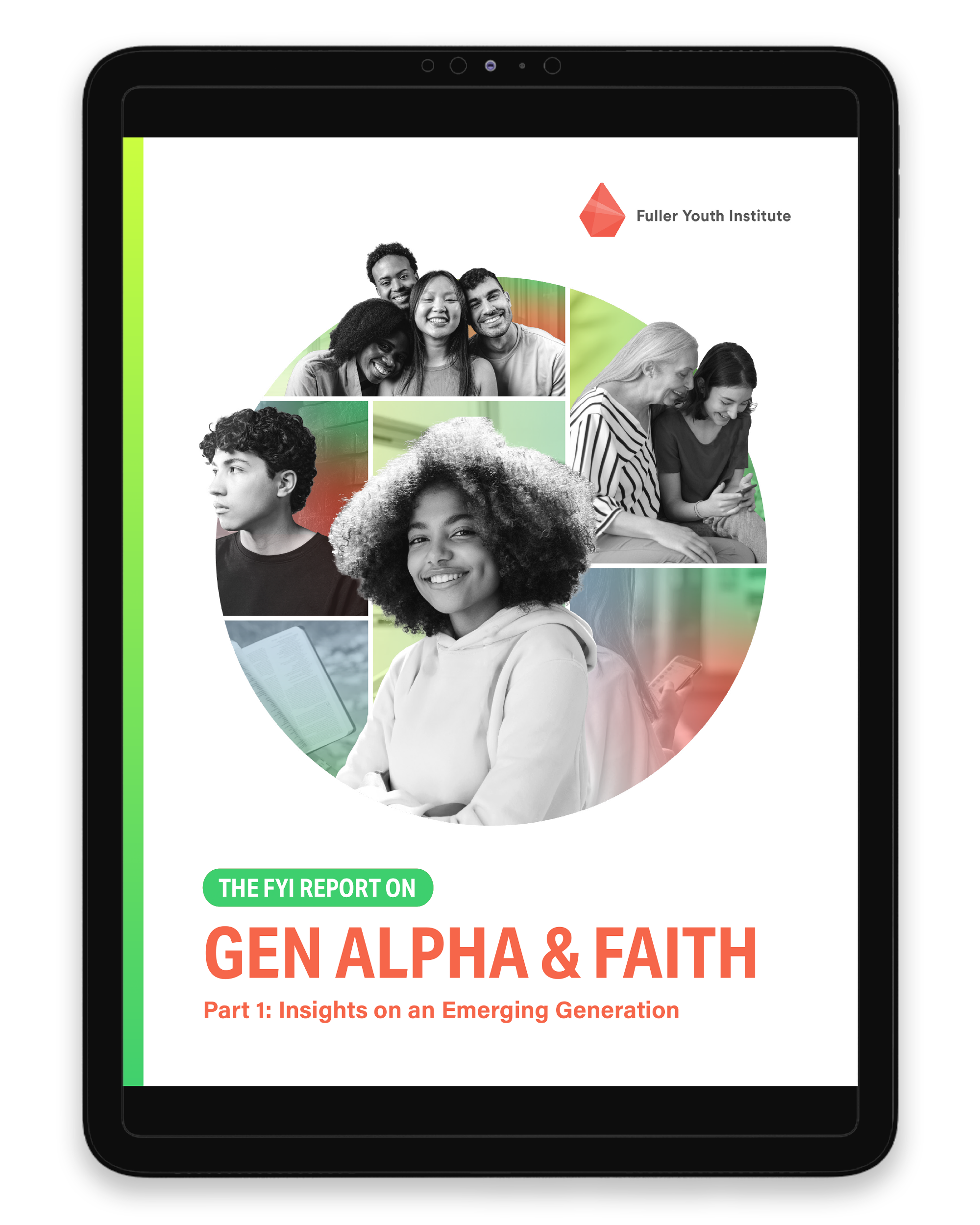
We’ve launched a brand-new research report designed specifically to help ministry leaders like you disciple faith effectively with today’s teens.
The FYI on Gen Alpha goes beyond trends and theory, equipping you with practical, ministry-ready insights you can apply today. Inside the report, you’ll discover:
- How Gen Alpha teens are thinking about faith and spirituality
- Why family matters more than ever
- What helps faith stick—and what pushes teens away
- Practical guidance for ministry that keeps conversations open and trust strong
Download the full report today and equip your ministry with insights to disciple today's teens for lasting faith.
Download the GAP Research Report
[1] The Annie E. Casey Foundation, “Population by Birth Cohort Generation and Race and Ethnicity,” KIDS COUNT Data Center, September 2025, https://datacenter.aecf.org/data/tables/11504-population-by-birth-cohort-generation-and-race-and-ethnicity?loc=1&loct=1
[2] Houltberg, B. J., Scales, P. C., & Williams, J. “Developmental Relationships: The Roots of Positive Youth Development—10 Years of Youth Voice, Practitioner Wisdom, and Research Insights.” Search Institute, 2023.
[3] Youvan, D. Existential Crises in Modern Adolescence: The Impact of Global Suffering and the Search for Meaning (2024). https://doi.org/10.13140/RG.2.2.27612.19846
[4] Weinstein, E., Sara Konrath, Lara, E., Tench, B., James, C., Mann, S., & Lenhart, A. Unpacking Grind Culture in American Teens: Pressure, Burnout, and the Role of Social Media (p. 60). Common Sense Media (2024). https://www.commonsensemedia.org/sites/default/files/research/report/2024-unpacking-grind-culture-in-american-teens_final-release-updated-for-web.pdf
[5] Haidt, Jonathan. “Why Social Media Harms Girls More than Boys.” In The Anxious Generation: How the Great Rewiring of Childhood Is Causing an Epidemic of Mental Illness, 1st ed. Penguin Publishing Group (2024).
[6] Gotlieb, Rebecca J. M., Xiao-Fei Yang, and Mary Helen Immordino-Yang. “Diverse Adolescents’ Transcendent Thinking Predicts Young Adult Psychosocial Outcomes via Brain Network Development.” Scientific Reports 14 (1): 1–11. 2024. https://doi.org/10.1038/s41598-024-56800-0.

David Martinez is a Research Project Coordinator at the Fuller Youth Institute (FYI). David received his Bachelor's in Social Work and Leadership and Ministry from Harding University. Originally from Mobile, AL, David relocated to Pasadena, CA with his wife in 2023. David is passionate about translational research, community development, and youth ministry. During his college years, he served in multiple youth ministries, supporting efforts to foster faith development among young people. Outside of work, David enjoys exercising, going to the beach, drinking coffee, and spending time with friends and family.
More from this author
More From Us




Sign up for our email today and choose from one of our popular free downloads sent straight to your inbox. Plus, you’ll be the first to know about our sales, offers, and new releases.