The 7 transitions shaping young adult faith (and how churches can support them)
 Steve Argue, PhD | Oct 16, 2025
The young adults in your community make more geographical moves, experience more job change and loss, and report more mental health challenges than any other age group your church serves. In short, emerging adults spend most of their time, energy, and focus on the transitions happening in their lives. This truth alone can shift your ministry and mentoring approaches to support young adults in the ways they really need and want you.
As our team at the Fuller Youth Institute has undertaken over a dozen years of research into effective ministry with and for young adults, every leader we’ve listened to has expressed a desire to show up for young adults and be a hopeful voice in their lives. The challenge they tell us about is not the desire to show up but how to show up. Many leaders expressed concern that, when given the opportunity, they don’t know what kinds of conversations to have with young adults, which makes them miss or even avoid these conversations altogether.
Through our research team’s expansive literature review, we identified seven significant life transitions young adults were most likely to encounter. We further tested our findings by surveying and interviewing 1,044 young adults who identified as Christian and concluded that these seven kinds of transitions are indeed evident and relevant.
Let’s dive deeper into what kinds of transitions we’re talking about. These are more than categories—they capture what young adults care about. While it’s important to understand generally what transition is, young adults revealed to us that they were working through very specific transition experiences and sought particular resourcing and support for how they see themselves, relate to others, and invest in their lives.
Seven transitions every young adult is likely to navigate
Identity Transition: Who I’m becoming in all its complexity and intersectionality. Young adults seek to understand themselves in light of their gender, race, ethnicity, sexual orientation, and religious identity by accepting, rejecting, harmonizing, and pursuing who they identify as and with.
Relational Transition: Who I’m trusting in light of my past, present, and future relationships. Young adults are working to deepen relationships with some, set boundaries with others, and seek new relationships, too.
Contributing Transition: What I’m contributing to for the betterment of myself and others. For young adults, this is both aspirational (What do I want to do with my life?) and practical (how will I pay the bills/), and they wrestle with this tension as they clarify their purpose in the world.
Responsibility Transition: How I’m bearing more of the weight and direction of my life and relationships, once held by other adults. Young adults inherit more of the weight of their own lives, relying less on their parents/guardians and taking responsibility for themselves.
Self-Care Transition: How I’m caring for myself now that my well-being is up to me. Young adults discover that their physical and mental well-being is now up to them, including healthy habits, doctors' appointments, seeking medical help, or working through recovery.
Adapting Transition: Where I’m putting down shallow roots, trying to thrive here. Young adults seek to establish themselves in new living or working environments that require them to know how to succeed and whom they can trust, all while wondering how long they’ll be in this place until they need to move again.
Meaning Making Transition: How I’m seeking to make sense of my life, connecting my spirituality with a community. Young adults are actively seeking to connect their beliefs with a community that shares their values and helps them live out these beliefs.
Your tool for better connection with young adults you care about
When I presented the seven transitions at an event, a young adult came up to me afterward and asked, “Have you been reading my journal?” These are the conversations young adults want to have. As a pastor, mentor, or parent, understanding the seven transitions young adults experience can help you identify helpful categories to listen for and connect specifically, rather than generically, as they navigate a particular transition in their lives. Keep in mind the following:
Young adults are likely to experience at least one of the seven transitions.Use these seven transitions as helpful frames of reference to start a conversation about an area in a young adult’s life where they feel in-between, stuck, or unsure about how to move forward. Offer young adults language to talk about and express what they’re experiencing.
Help young adults identify the transition they’re most focused on right now. Often one transition experience is impacted by (or impacts) another. But likely, there’s one transition that’s fueling the most excitement, pressure, or worry in a young adult. Focus your energies there and unpack one transition at a time. This will bring clarity and even a little relief from feeling overwhelmed. Seek to understand what a young adult’s hopes, fears, and needs are, and respond specifically in the ways they need your support.
Treat the 7 transitions as language for understanding, not labels for controlling. Life’s transitions aren’t something to be avoided. In fact, they signal that young adults are ready to make important changes. Use these insights to listen with understanding. Match their concerns and needs with the right encouragement, resources, and support that help them grow in transition, not just get through it. Life transitions can also be opportunities for spiritual transformation.
Here are three ways to put these insights into practice today:
- Pull some of your leaders together and ask yourselves, “How might our faith community support young adults experiencing [one of the seven] transitions? Do this for each transition and brainstorm what resources you have available to support them.
- Ask young adults you know., “Where are you feeling the biggest change in your life, and how would you describe it?” Listen to their responses and try to understand which transition might be most pressing for them right now.
- Take this list of seven transitions and ask a group of young adults to mark those they’ve experienced or are experiencing in their twenties. Learn from their stories as they share with you.
The best way to support young adults and the way they prefer to be supported is by understanding their challenges and experiences. Allow these seven transitions to be one way to invite the conversations young adults really want to have.
Free Download! 7 things you need to know for successful young adult ministry
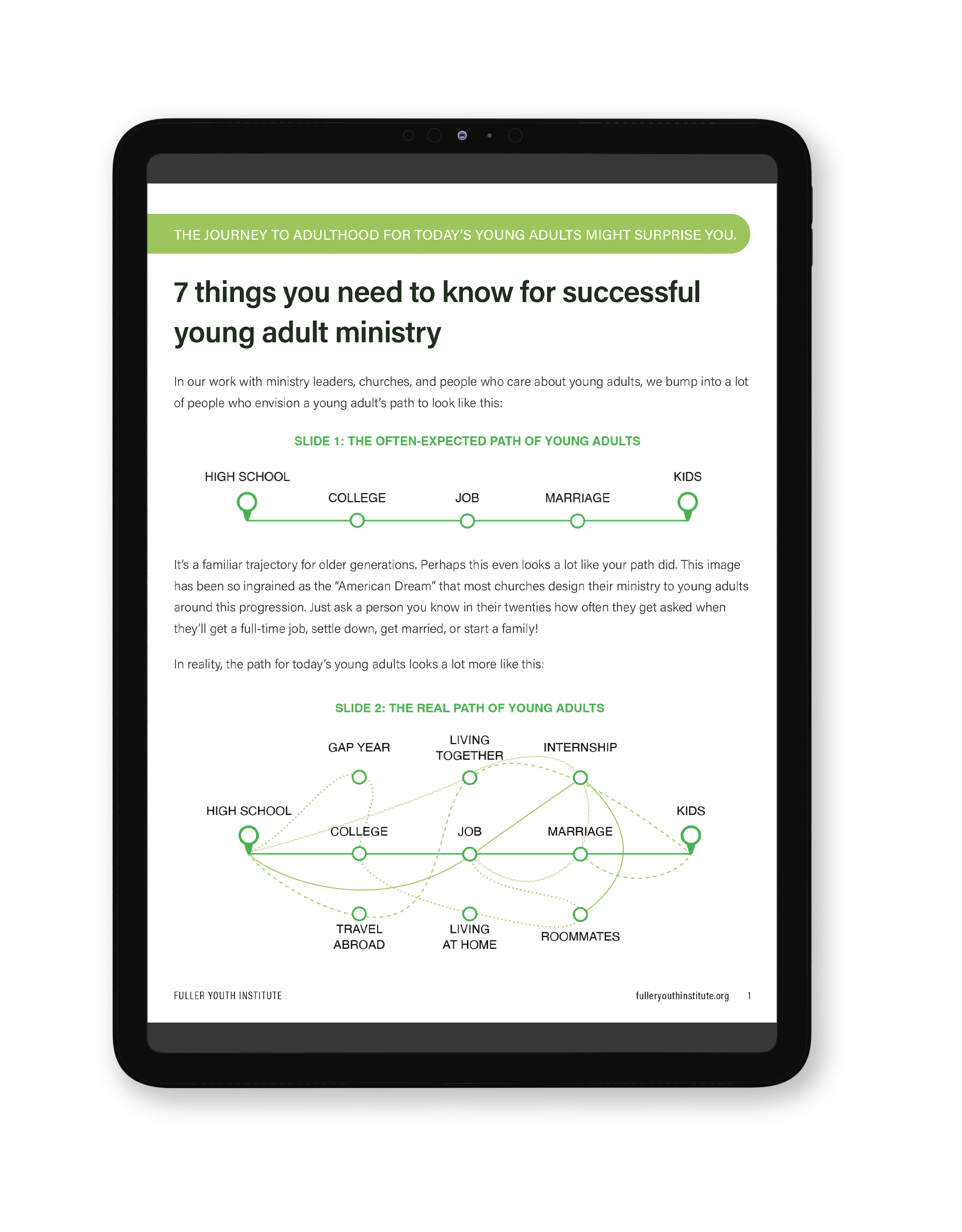
Complete the form below to download this free guide. Discover key research insights and practical steps you can take through 7 challenges young adults face today.
Lead real conversations about topics today’s young adults care about

Young adults are often on the move—pursuing education, taking career steps, forming relationships, taking on responsibilities, and more. Our young adult ministry discussion guides are designed to help ministry leaders and mentors walk alongside young adults through the most common transitions that young adults face.
Each research-driven guide features thought-provoking questions that create space for authentic conversations about the real stuff of life and reminds young adults God is with them, their faith still matters, and the community around them can support their journey.

Steven Argue, PhD (Michigan State University) is the Applied Research Strategist for the Fuller Youth Institute (FYI) and Associate Professor of Youth, Family, and Culture at Fuller Theological Seminary. Steve researches, speaks, and writes on adolescent and emerging adult spirituality. He has served as a pastor on the Lead Team at Mars Hill Bible Church (Grand Rapids, MI), coaches and trains church leaders and volunteers, and has been invested in youth ministry conversation for over 20 years. Steve is the coauthor and contributor of a number of books, including Growing With, 18 Plus: Parenting Your Emerging Adult, and Joy: A Guide for Youth Ministry.
More from this author
More From Us






Sign up for our email today and choose from one of our popular free downloads sent straight to your inbox. Plus, you’ll be the first to know about our sales, offers, and new releases.